People can be enriched by their own cultures and the cultures they connect with throughout their lives. Archive

2R at the Friday Assembly!

Posted November 2, 2012 By jzraskin@gmail.com

A re-post from the YIS Elementary Blog…

On Friday 2nd November 2012, elementary held it’s weekly morning assembly under a clear sunny blue sky! The Grade 5 hosts did a fantastic job running the schedule. The assembly was also well attended by parents and visitors!

First, there was some birthday announcements for Ms Nanwani and Ms Quinn, and a special cheer for “Happy Halloween”.

Next, Grade 4N shared their learning from their recent Unit of Inquiry, Where We are in Place and Time; People continue to migrate for many reasons. Students shared facts about the Ainu culture through a creative “Do you know… ?” skit.

Then, Grade 2R performed an Australian story that was part of their Grade 2 Cross Cultural Lunch. The students told an Australian Indigenous story from the Aboriginal Dream time, where they sang and played Orff instruments and acted out parts of the story.  The elementary music teacher, Ms Bridgewater, had collaborated with Grade 2 on their Unit of Inquiry, Where We are in Place and Time; People can be enriched by their own cultures and the cultures they connect with throughout their lives.

Friday Morning Assembly from Shanel Catasti on Vimeo.

Afterwards, the PTSA representative reminded the school community to come along to the YIS International Food Fair on Sunday 3rd November, from 10:00-15:30. After a few announcements from Ms. Pender, the Grade 5 hosts wishes everyone a “Freaky Friday”!

1 Comment. Join the Conversation

The first unit of inquiry grade two embarked on this year was a study of ways in which we are enriched by our own cultures and the cultures we connect with throughout our lives.

As we began asking questions along a line of inquiry exploring similarities and differences between cultures, we struggled with ways to collect and make sense of the answers.

Among the Mathematics learning outcomes for this year, in the Data Handling strand, is the Conceptual Understanding that Data can be collected, organized, displayed and analyzed in different ways. This was a perfect opportunity to bring together Maths learning with our Inquiry studies.

Students began by building on the sort of questions that had been bubbling up already by brainstorming a wide range of curiosities about differences and similarities amongst families and cultures.
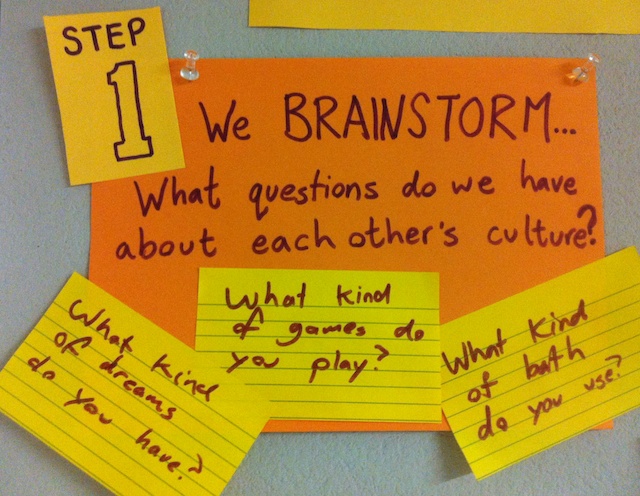
I challenged them to find answers to their questions from our class. Each student chose a different question of personal importance or interest and used their previous knowledge of collecting answers to their questions to go about surveying their peers.
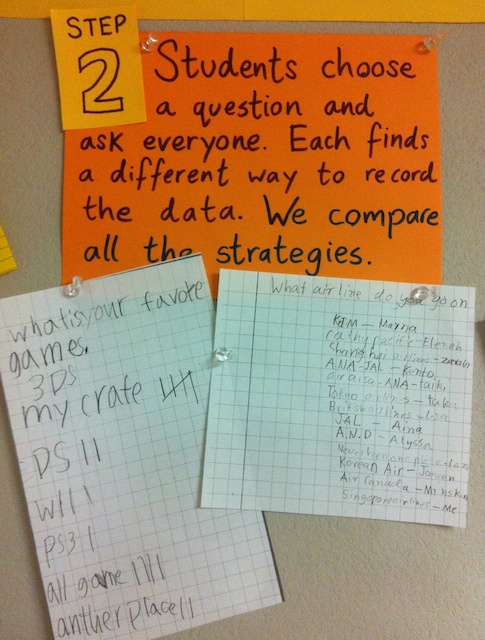
Each student had recorded the data in different ways so we took some time to analyze the features of their data collection systems and students explained the thinking behind their strategies. One student recalled having made graphs of data in the past, as a way of clearly presenting the information, so students discussed what they remembered about this, and had a go at making their own from the data they’d collected.
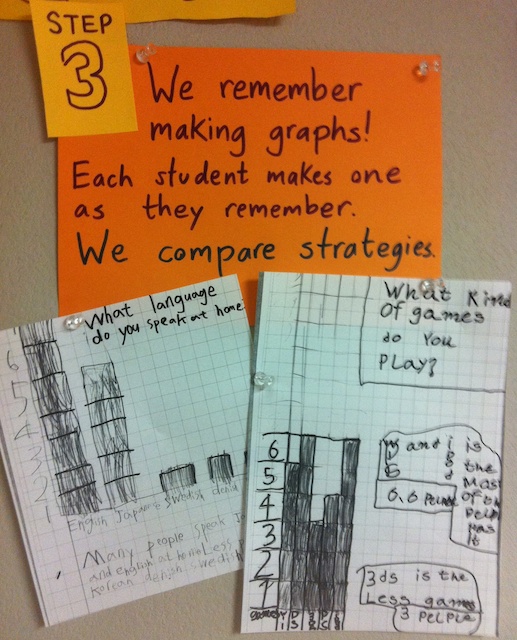
We compared the varied graphing strategies students had used and the conclusions they had been able to draw from their data. We followed this with a discussion of what we thought some of the most successful features of data collection systems had been, that had allowed for us to most clearly, accurately and quickly collect information.

In small groups, students worked together to build new data collection tools, based on our previous discussions and examples, to most effectively get answers to the questions they were posing.

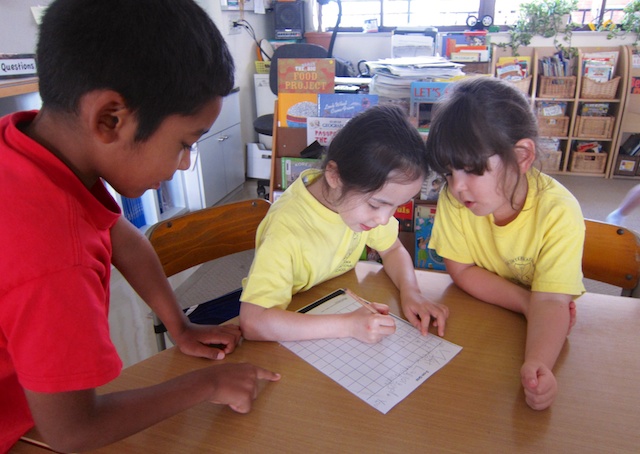
 

Students collaborate on a data collection tool.

With these complete, groups presented their tools to the class and used the questions and suggestions to refine their tools before trying them out.
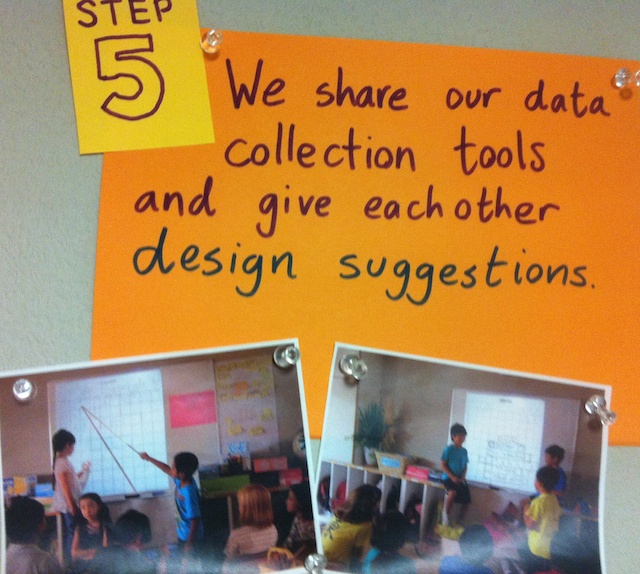
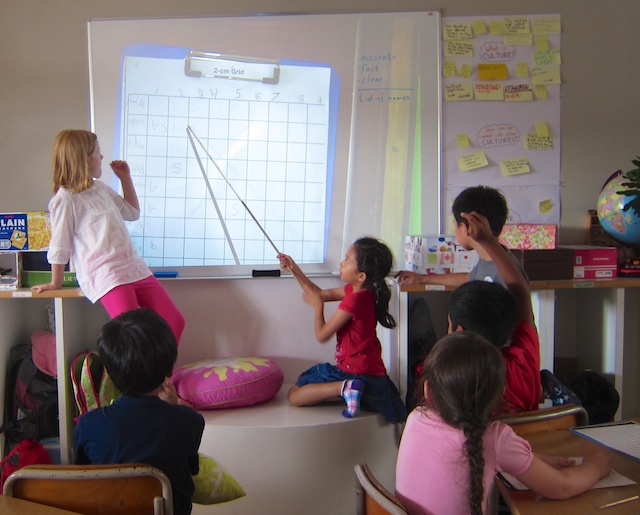
Students present their collaboratively-created tools for class questions and suggestions.

Finally, it was time to put our team-created and class-critiqued tools to the test, by surveying the class. How accurate, clear and fast would the tools allow our data collection to be?
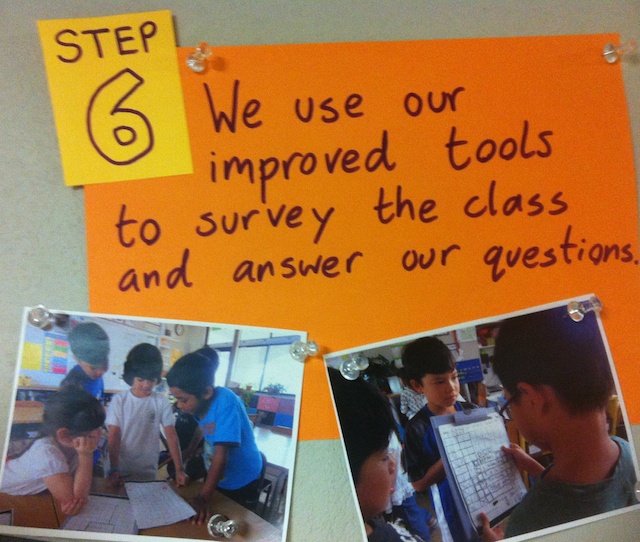
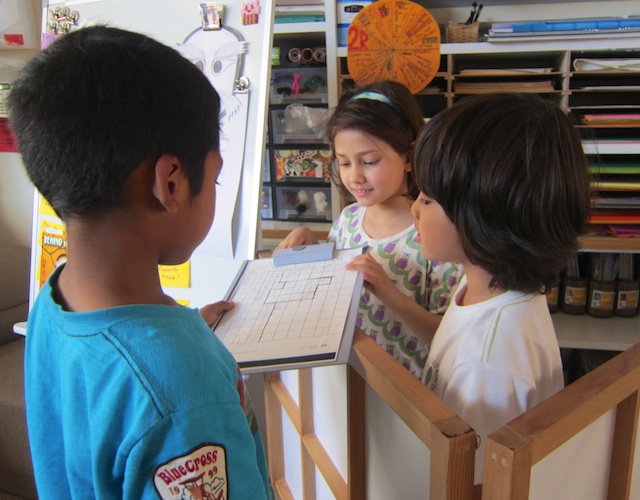
 

Students test their tools by surveying their peers.

Having collected data with their tools, groups used the Two Stars and a Wish reflection strategy to identify two elements that had worked exceptionally well about their designs, and one feature they could improve upon.
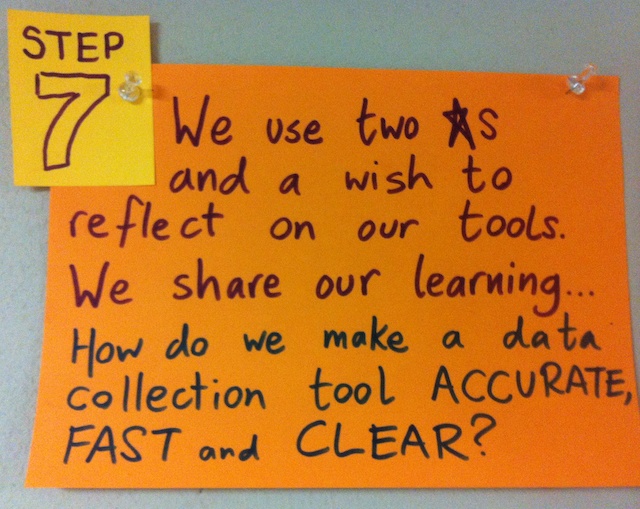
We shared these with the rest of the class and developed a collaborative list of features we all considered key to making a data collection tool as Fast, Accurate and Clear as possible.
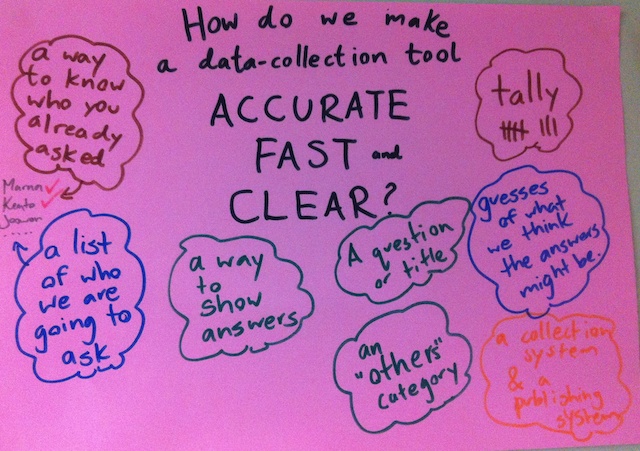
Students used this list to support their posing of a final, independent question. They each created their personal, ultimate data collection tool and surveyed the class.
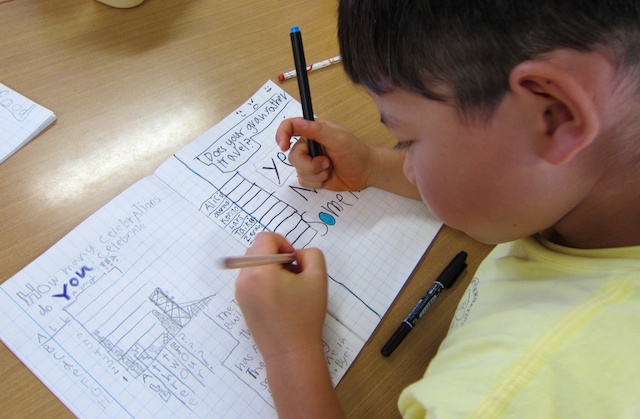
Students apply new understandings in creating their own super-data-collection tools.

Finally, we came back to the discussion of graphing and presenting our data. I introduced the simple graphing features of the Pages application to the class and we looked at how our understanding changed depending on the wide variety of ways we could display the data. Some students considered pie graphs to be most appropriate for communicating their answers, others preferred bar graphs. Each student explained the thinking behind their choices for a way to present their data.
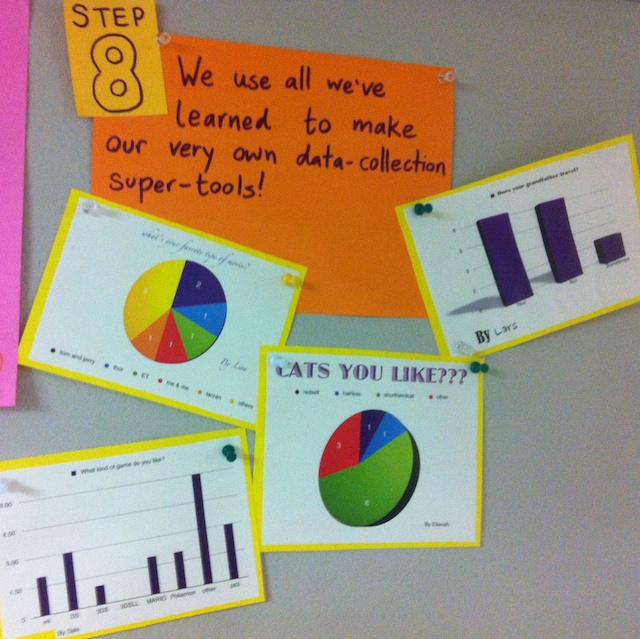
We reflected on our learning through this process as being a design cycle. We looked at our original data collection tools and graphs, how they’d been improved through discussion and group work, then further improved by presentation and critique, tested by trying them in action, better understood through reflection and sharing our learning and finally improved in our individual final tools and graphs.
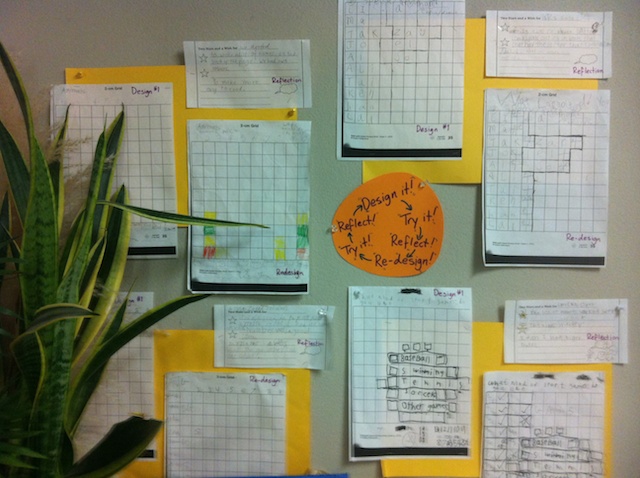
In reflection, one student mentioned proudly how much better his final survey and graphing worked, compared to his first attempt. Yes, agreed another, but we could still make them better next time…

—–

The orange posters above are from the classroom display I created to document this inquiry process. All photos are my own.

5 Comments so far. Join the Conversation

Mr. Raskin’s Culture Collection

Posted September 19, 2012 By jzraskin@gmail.com

Use this Voicethread to take a look at my culture collection. If you’d like to leave a comment, question or connection, that would be great! You can use video, audio, text or drawing!

5 Comments so far. Join the Conversation

2R Taiko!

Posted September 16, 2012 By jzraskin@gmail.com

As part of our unit of inquiry People can be enriched by their own cultures and the cultures they connect with throughout their lives, second grade have had the opportunity to collaborate and get a taste of many of the programs at YIS’s International Center for Japanese Culture. Check out earlier posts for details on our experiences with Japanese Calligraphy, Dance, Sushi-Making and more. This week we were invited for a taste of Taiko drumming. Enjoy our mini video-slideshow!

Taiko Drumming for 2R! from YIS 2R on Vimeo.


5 Comments so far. Join the Conversation

Japanese Dance & Calligraphy

Posted September 8, 2012 By jzraskin@gmail.com

What amazing opportunities second grade has had this year to experience parts of Japanese traditional culture. Continuing on our Sushi-making experience of a few weeks ago, we have been invited back to the ICJC to experience Japanese Dance and Calligraphy. A wonderful integration with our current unit of inquiry: People can be enriched by their own cultures and the cultures they connect with throughout their lives. Check out the gallery and let us know what you think!

3 Comments so far. Join the Conversation

2R Sushi-Making!

Posted August 28, 2012 By jzraskin@gmail.com

As part of our Unit of Inquiry exploring how our lives are enriched by our own cultures and the cultures we connect with, Grade Two were invited to the ICJC to learn how to make sushi! Keep an eye out for our Japanese Dance class next week!

5 Comments so far. Join the Conversation

Culture Walk!

Posted August 22, 2012 By jzraskin@gmail.com

Today 2R braved the heat and set out for a Culture Walk around the neighbourhood to see what we could find that we connected to Japanese and other cultures. Students busily noted their findings in their inquiry notebooks and had lots of compelling questions about the origins of everything around them! It was amazing to see how purposefully looking for culture made us look at our surroundings in a whole new way.

Highlights included thinking about how everything from bamboo to vending machines could be a sign of Japanese culture, lots of water breaks in the shade, and having Alicia teach us all how to wash our hands before going to the temple! Thanks to the Japanese department for supporting us to make it happen!

10 Comments so far. Join the Conversation

Culture Walk

Posted January 23, 2012 By jzraskin@gmail.com

This week’s post is from Airi, in her words…

We went to like a walking. We saw a beer place then, we went the place makes TATAMI. They were sewing TATAMI. We went to the DANGO shop and we bought MITARASHI DANGO. Then we went to the shrine. After that we saw a bakery. We were so lucky to see that they were making breads! We came back to school, then we ate little bit of snack, and we ate DANGO.

We are walking to go to a park.


2 Comments so far. Join the Conversation

The International Lunch

Posted January 23, 2012 By jzraskin@gmail.com

What a great event!

Second grade were fantastic performers, very effective in sharing the learning from their most recent unit of inquiry, and the food contributed by all the families was delicious!

Ms. Catasti, our elementary vice-principal wrote a great blog post about it here. The post included the video below, and more. Take a look!

Grade 2 International Lunch from Shanel Catasti on Vimeo.

Thanks to everyone for your contributions!

Be the first to comment

Kug doch mal

Posted December 5, 2011 By jzraskin@gmail.com


Today’s writing is from Femke, in her own words.

She wrote in her mother tongue, German.

She is saying hello to her mum from 2R.

Read below for a translation from Elena, too!


“Hallo mama!

Wie gehd  es dir?

mi rgehd es gud

ich komme ja um drei wieder nach Hause.”

von Femke

“How are you? Are you good or not?  I am going home today.”

From Femke (Translated by Elena)

3 Comments so far. Join the Conversation