Before visiting the Nogeyama Zoo, second grade spent an hour or so looking at the list of species we would encounter, and finding images of them in their natural habitats. We printed several dozen of these and made a book of them to bring with us to compare with their zoo enclosures.
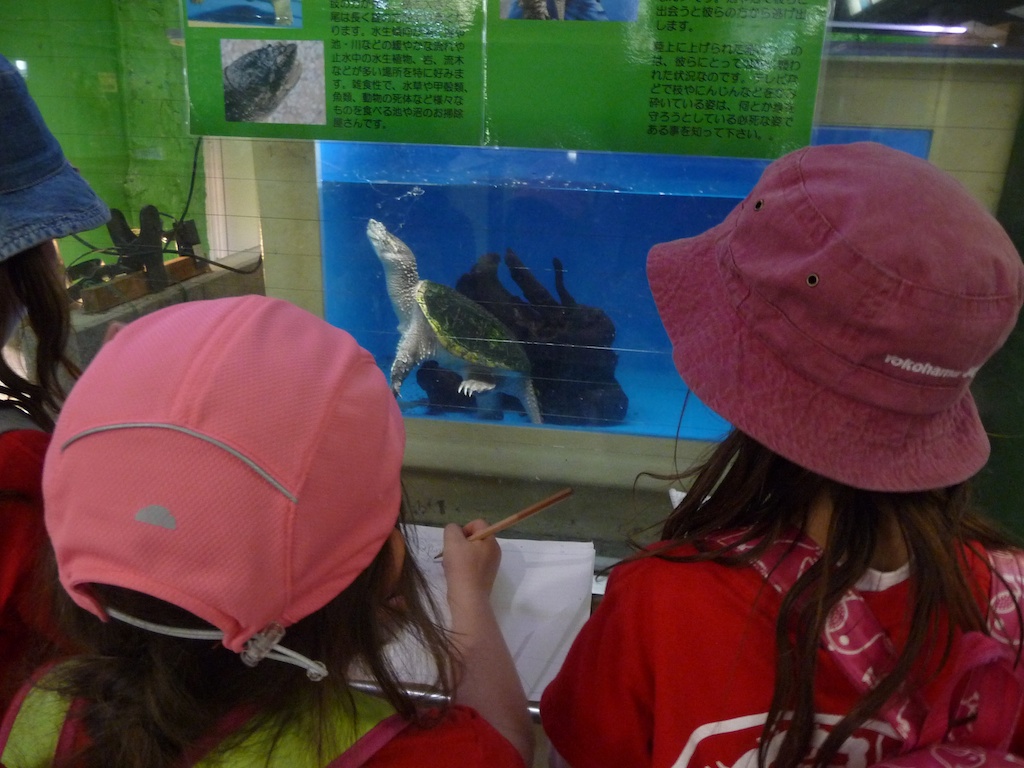
Hannah & Marna compare the snapping turtle enclosure to its natural habitat they’d researched.
Shortly after arriving, most of 2R were looking at a pair of baboons, grooming each other in their cage when the activity in the neighbouring cage caught our attention. Several students had noticed that the large male chimpanzee was clapping his hands, and would clap back at them when they clapped. They became excited with clapping and soon began hooting and calling out at him. As we all watched, the chimpanzee seemed to get very agitated and worked up. He dashed to the large metal door at the back of his cage and began pounding on it aggressively, louder and louder and faster and faster. After a minute of this he turned and ran towards us at the front of his cage, jumping and throwing his body up at the plexiglass wall that separated us with a bang.
Chimpanzee at Nogeyama Zoo from YIS 2R.
The students were shocked and we slipped around the corner to confer quickly on what had just happened. Students had a range of reactions.
Lars thought that perhaps he was excited by all of our red field trip t-shirts.
Taiki thought he was excited to see us.
Marna and Ellenah suggested that maybe he was embarrassed by knowing that we were talking about him and sort of teasing him, without knowing exactly what we meant.
Other students suggested that he was angered by all the noise we were making and that his pounding on the door showed that he wanted to get out.
As we stood, huddled, discussing, the chimp continued banging loudly and let out a series of howls.
One student suggested that we may want to go back and watch him very quietly to see if it made a difference in his reactions. Without discussion, we all took on this idea and slowly slipped back in front of his enclosure.
Standing quietly in front we experienced a very different interaction. The chimpanzee sat quietly like us. Watching us, with his head bobbing side to side. For almost a minute this continued in silence.
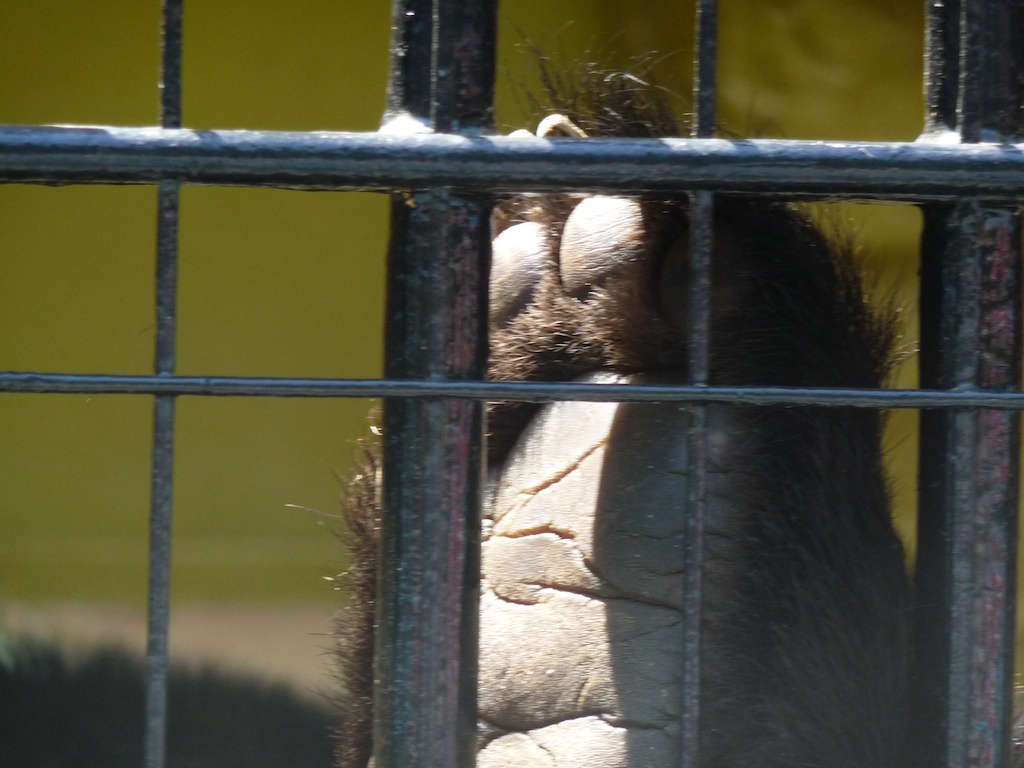
The foot of the Moon Bear in the Nogeyama Zoo.
The next morning, we spoke about how powerful the moment had been for many of us. We decided to use a Visible Thinking routine called Step Inside: Perceive, Know About, Care About to try to better understand our experience. Several students took turns improvising in the role of the chimp, exploring what he perceived, knew about and cared about as a way to try to understand his point of view. A very powerful experience for many of us.
Marna improvises in the role of a chimp at the zoo from YIS 2R on Vimeo.
Sojiro improvises in the role of a chimp. from YIS 2R on Vimeo.
Lisa improvises in the role of a chimp from YIS 2R on Vimeo.